Working in dental media, I see incredible clinical photography every week — buried in folders, scattered across devices, never used. I sat down with Alexia from Dentalfolio, and she may have solved the problem for good.
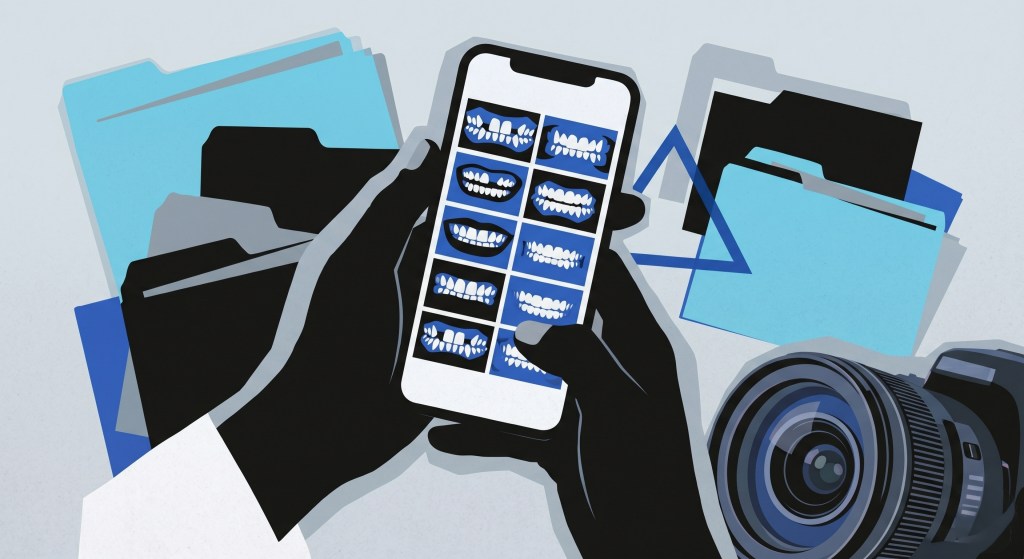
One of the things I’ve come to notice working in dental media through 230 Media is just how much brilliant clinical photography never sees the light of day. Dentists invest real effort — good equipment, proper lighting, careful technique — and then the images land on an SD card, get dumped into an unlabelled folder on a desktop, and quietly disappear.
From a content and media perspective, that’s a real shame. When we work with practices on their photography, we see first-hand how powerful those images can be — for social media, for patient consultations, for showcasing the standard of work a practice is capable of. The photography itself is rarely the problem. The workflow around it is.
So when I met Alexia at the BDIA Dental Showcase at London ExCel, and she told me she’d built an app specifically to fix this, I wanted to hear everything.
Meet Dentalfolio
Dentalfolio is a photography app and ecosystem built for dentists — designed to help them capture, organise, and present their clinical photographs without the usual admin overhead. What makes it credible is that Alexia isn’t just a developer who spotted a market gap. She’s a practising associate dentist who lived this problem herself for years.
“I kept getting a portfolio prepared. I have maybe 20 portfolios. And so when the patient’s there, I don’t know which one it is.” — Alexia, founder of Dentalfolio & associate dentist
The app works for both DSLR photographers and smartphone shooters. You import photos from wherever they end up — SD card, iCloud, Dropbox — and from that point, your entire case library is organised and searchable from your phone, iPad, or browser. A before-and-after can be pulled up in seconds, even between patients.
Why this matters for your content
From a media standpoint, this is the missing piece. I’ve seen practices spend money on professional photography shoots, then struggle to find those images six months later when they need content for a campaign. Meanwhile, the real gold — ongoing case documentation, before-and-afters, the steady accumulation of clinical work — sits completely untapped.
Authentic clinical photography, when it’s actually accessible and presentable, consistently outperforms polished generic imagery. Patients respond to real work. A dentist who can pull out their phone mid-consultation and show a genuinely comparable case builds trust in a way that a stock photo simply can’t. Alexia puts it well:
“I want to show them cases that I’m doing, the growth that I have. It makes me much more excited and when I present it to the patient, there’s a connection there — we’re both looking at something exciting.”— Alexia, Founder of Dentalfolio
The compliance angle worth knowing
Something that came up in our conversation that I think is underappreciated: most dentists storing patient photos on personal camera rolls or unlabelled desktop folders are likely outside GDPR compliance. Patient images are sensitive personal data, and the storage location, encryption, and consent framework all matter.
Dentalfolio has built this in from the ground up — encryption at the backend, dual-layer phone security, the dentist as data controller, and consent built into the workflow. Alexia told me patients visibly relax when she explains it’s purpose-built clinical software. For dentists in Australia, the same principle applies under the Australian Privacy Act.
Completing the triangle
Smile simulation has had a lot of attention lately — Invisalign, intraoral scanners, various brands have invested heavily in showing patients a projected outcome. It’s effective. But Alexia makes a point that stuck with me: simulation tells a patient what’s possible, but your actual case library tells them you can do it. One without the other is only half the story.
“Alongside the simulation, you should be showing cases of the work that you have done as well. It completes the triangle.”— Alexia, Founder of Dentalfolio
That’s a framing I’ll be using when I talk to practices about their content strategy going forward.
Where to find Dentalfolio
The app is live on the App Store now. You can follow along on Instagram at @dentalfolio.app, or find Alexia personally at @alexia_dental. If you’ve got questions, Alexia mentioned it’ll be her personally on the other end of the DMs.
Visit dentalfolio.app to download the app — available on iOS, built for both DSLR shooters and smartphone photographers.