A practical guide for Australian dental practices who want to document real clinical work — without ending up in front of the regulator.
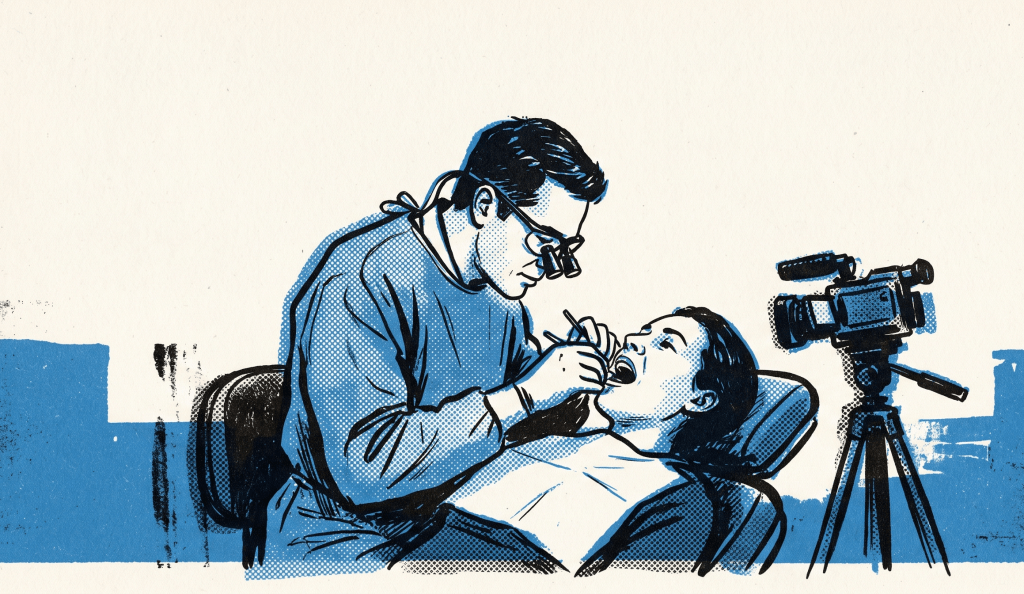
Every dentist I talk to wants the same thing: footage that proves the craft. The micro-detail of a veneer prep. The moment a composite gets sculpted into a tooth that finally looks like it belongs. The patient walking out with a smile they haven’t worn in years.
And every dentist I talk to is also quietly terrified of AHPRA.
So they don’t film. Or they film, and the footage sits in a drawer. Or worse — they post something they shouldn’t, get a complaint, and the practice goes quiet for six months while their lawyer drafts a response.
Here’s the truth most marketers won’t tell you: you can film almost anything in a dental surgery. What you can’t do is publish it without thinking. The rules aren’t about the camera. They’re about the message.
Let’s break down what AHPRA actually says — and how to film in a way that builds trust, books cosmetic cases, and keeps you well inside the guardrails.
What AHPRA actually regulates (and what it doesn’t)
The relevant law is Section 133 of the Health Practitioner Regulation National Law[^1], plus the Dental Board of Australia’s Guidelines for advertising a regulated health service[^2] — the current version of which took effect on 14 December 2020[^3].
In plain English, Section 133 sets out five things advertising for a regulated health service must not do[^1]:
- Be false, misleading or deceptive (or likely to be)
- Offer a gift, discount or other inducement without stating the terms and conditions
- Use testimonials or purported testimonials about the service or business
- Create an unreasonable expectation of beneficial treatment
- Directly or indirectly encourage the indiscriminate or unnecessary use of a regulated health service
The Guidelines then add a sixth rule that bites hardest in cosmetic dentistry: don’t use images that misrepresent outcomes[^2].
The two that trip practices up most often when filming are testimonials and misleading imagery.
Notice what’s not on that list: filming a procedure. Showing your hands at work. Showing the patient’s face. Showing the clinical environment. None of that is illegal. It’s how you frame it that matters.
A quick word on the testimonials rule, because it’s the one everyone gets wrong. Section 133 itself bans “testimonials or purported testimonials” — full stop, no qualifier[^1]. But AHPRA’s Guidelines clarify what actually counts as a testimonial: a comment about the clinical aspects of care, which the Guidelines define as a symptom, a diagnosis or treatment, an outcome, or the skills or experience of the practitioner[^4]. Comments about customer service, communication style, or the environment are not testimonials for the purposes of the National Law[^4]. That carve-out is where most compliant patient content lives.
The 5 filming scenarios you’ll actually run into
1. Filming the procedure itself (intraoral, hands, instruments)
Allowed. Procedure footage — composite bonding, crown preps, veneer try-ins, scanner workflows — is educational documentation. As long as you’re not pairing it with a claim like “this patient was nervous and now she’s confident” (testimonial about clinical care), you’re fine.
What to film: macro shots of the tooth, the prep, the bond, the polish. The hands. The loupes. The scanner screen. The articulating paper. The light cure.
The Goosebump Factor lives in this footage. The slow reveal of a finished veneer. The first time a composite catches the light right. That’s not advertising — that’s craftsmanship documentation.
2. Filming the patient’s face or smile
Allowed, with proper consent. AHPRA doesn’t ban patient imagery. It bans misleading patient imagery and testimonials about clinical care.
You can show a smile. You can show a before-and-after. You cannot:
- Edit the after to look better than it does in real life
- Imply the result is typical when it’s exceptional
- Pair the image with a patient quote about how the treatment changed their life clinically
If you’re doing before-and-afters, shoot both under identical lighting, identical lens, identical distance. No filters. No retouching. Disclose treatment type plainly.
And — non-negotiable for any cosmetic before-and-after — include a clear “results vary between individuals” disclaimer. AHPRA’s guidance is explicit that outcome imagery in cosmetic advertising must carry a disclaimer making clear that results vary[^5]. A safe baseline:
Results vary between individuals. All procedures carry risks. Speak to your dentist for personalised advice.
Bake the disclaimer into the post itself — caption, on-image text, or video lower-third — not buried in a website footer.
For example in the video below that we filmed for Dr Karim Habib from Dental Square. We placed a disclaimer on the top left hand corner.
3. Filming the patient talking on camera
This is the danger zone. A patient on camera saying “Dr Smith fixed my chipped tooth and it looks amazing” is a clinical testimonial. That’s a breach.
A patient on camera saying “I love coming here, the team always remembers my kids’ names” is a service-experience comment, not a clinical testimonial. That’s fine[^4].
The line: testimonials about clinical aspects of care are out. Testimonials about customer service, environment, or team culture are in.
If you want a patient on camera, brief them clearly before you roll. Tell them what they can and can’t talk about. Have them sign a media release that explicitly covers AHPRA’s framework.
4. Filming the dentist talking to camera
Allowed and encouraged. This is where most cosmetic-conversion content lives. The dentist explaining how a veneer is bonded. The dentist walking through why they chose lithium disilicate over zirconia for a particular case. The dentist talking about their philosophy on minimally invasive cosmetic work.
Educational and philosophical content from the practitioner is not advertising in the regulated sense — it’s expertise on display. It builds trust faster than any testimonial would. And it’s exactly what cosmetic patients are searching for when they’re three months away from booking.
5. Filming behind-the-scenes (team, environment, lab)
Allowed, no consent issues beyond your team’s own media releases. The waiting room. The sterilisation bay. The lab tech glazing a crown. The morning huddle. The principal’s coffee at 7:30am before the first patient.
This is the most underused footage in dentistry. It humanises the practice without touching a regulated claim.
The consent form question (don’t skip this)
Most dental consent forms cover treatment. They don’t cover media. If you’re filming patients in any capacity — even just hands-in-mouth with no face visible — you need a media-specific consent that covers:
- Photography and video, both clinical and non-clinical
- The platforms you may use the footage on (web, Instagram, TikTok, Meta ads, YouTube, training)
- The duration of the licence
- The right for the patient to withdraw consent in future (and what happens to existing content)
- AHPRA-specific language acknowledging the patient understands their footage will be used in a regulated-advertising context
We wrote a full breakdown of this in our dental consent form guide — worth reading before your next shoot.
The five-step pre-shoot AHPRA check
Before you film, run this checklist:
- What’s the message? If you can’t describe it in one sentence without using the words “amazing,” “life-changing,” or “painless,” rethink the angle.
- Who’s on camera? Patient, dentist, team, or no one? Each has different consent requirements.
- Is there a testimonial? If a patient is speaking, is anything they say about clinical care? Cut it.
- Are the visuals honest? Same lighting before and after. No retouching. No filters that change tooth shade. Results-vary disclaimer baked in.
- Is the consent paperwork current? Signed, dated, with platform scope.
If all five check out, you can film.
The bigger point
AHPRA exists to protect patients from misleading advertising. It does not exist to stop dental practices from showing their work.
The practices that grow are the ones who film constantly, stay inside the guardrails, and treat the regulator as a creative constraint rather than a creative ceiling. Constraints make better content. Always have.
If you want help building a content workflow that’s AHPRA-compliant from the first frame to the final cut, that’s what we do at 230 Media. We’ve been embedded in cosmetic practices across Sydney, Melbourne and Brisbane for years — every shot list, every consent form, every edit is built around the rules.
Film the craft. Show the work. Skip the testimonials. The rest takes care of itself.
Got a question about a specific shot or scenario? Reply to this post or DM us @230media.dental — we’ll answer.
Sources & further reading
[^1]: Section 133, Health Practitioner Regulation National Law. Lists the five advertising prohibitions: false/misleading, inducements without T&Cs, testimonials, unreasonable expectation of benefit, and indiscriminate or unnecessary use. See AustLII text (NSW application): https://classic.austlii.edu.au/au/legis/nsw/consol_act/hprnl460/s133.html
[^2]: Dental Board of Australia, Guidelines for advertising a regulated health service. Issued jointly by all National Boards via AHPRA. Available at: https://www.dentalboard.gov.au/Codes-Guidelines/Advertising-a-regulated-health-service.aspx and https://www.ahpra.gov.au/Resources/Advertising-hub/Advertising-guidelines-and-other-guidance/Advertising-guidelines.aspx
[^3]: Dental Board of Australia news item, Guidelines for responsible advertising in effect today (14 December 2020): https://www.dentalboard.gov.au/News/2020-12-14-news-item-advertising.aspx
[^4]: AHPRA, Testimonials: Understand the requirements (Advertising hub). Defines “clinical aspects” as symptom, diagnosis or treatment, outcome, or the skills or experience of the practitioner, and confirms that comments about customer service or communication style are not testimonials for the purposes of the National Law: https://www.ahpra.gov.au/Resources/Advertising-hub/Resources-for-advertisers/Testimonial-tool.aspx
[^5]: AHPRA, Advertising hub — Advertising guidelines and other guidance (use of patient images, before-and-after imagery, and outcome disclaimers): https://www.ahpra.gov.au/Resources/Advertising-hub/Advertising-guidelines-and-other-guidance.aspx. See also the Dental Board’s compliance reminder on advertising rules (6 May 2024): https://www.dentalboard.gov.au/News/2024-05-06-Dental-Board-urges-compliance-with-advertising-rules.aspx