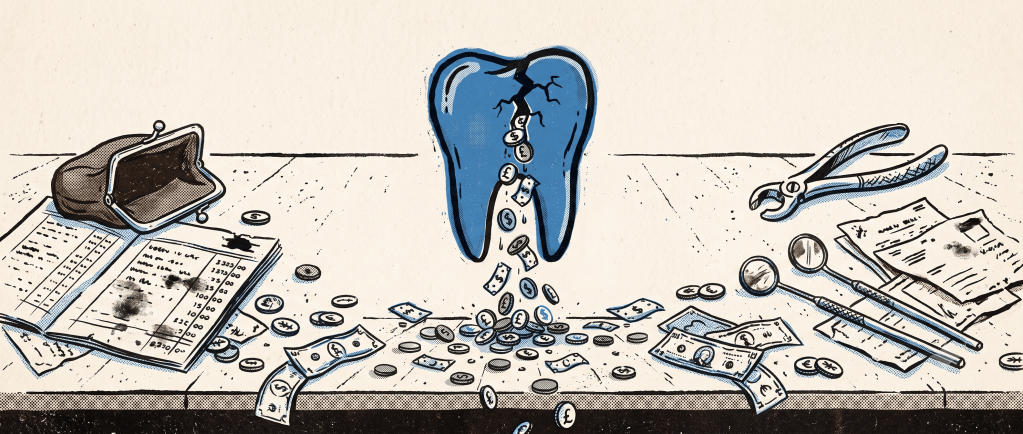
Most dental practices don’t lose money in one dramatic moment. They lose it in small, quiet ways — a discount here, an unbooked follow-up there — that never show up as a single line on a report but quietly drain thousands every month.
We recently sat down with Michelle Pritchard of Aligned Business Consulting to talk about exactly this: the top money leaks she sees walking into practice after practice. Michelle helps dental business owners who are overwhelmed wearing every hat — owner, manager, and practitioner — get back to what they actually love: practicing dentistry. And her perspective is worth listening to, because she’s lived both sides of it.
From the books to the business
Michelle didn’t set out to work in dentistry. She has a banking, finance, and commerce background, and her entry into the industry was abrupt. “When our baby was only three weeks old,” she told us, “my husband came home and said, ‘Congratulations, you’ve got a bookkeeper’s job.'” She and her late husband Ross went on to co-own and build a practice, set up bespoke systems, and eventually sold it profitably in 2015.
From there she moved into practice management — and found herself staring at the same problems she’d solved years earlier. “It was exactly the same position our practice was in 15 years earlier. Didn’t know where the money was going, no systems set up, money leaking everywhere.” That pattern, repeating across practice after practice, is what pushed her into consulting one-to-one and hosting her podcast, Dental Success: Beyond Chairside.
So where is the money actually going?
Leak #1: The discounts nobody’s tracking
The first leak is one most dentists don’t even know they’re creating. “Dentists give discounts and they don’t realize it,” Michelle explained. A compassionate practitioner sees a nervous patient, quotes the price, senses hesitation, and quietly “knocks a bit off.” It rarely feels like a discount in the moment — it’s a “courtesy,” an adjustment, rounding $2,000 down to $1,500.
Multiply that across a week, and the numbers get alarming. Michelle shared a story from another consultant who reviewed one dentist’s book and found he’d given away $16,000 in discounts in a single month — largely without realizing it. When you’re doing it several times a week, it stops being kindness and starts being a serious hole in the bottom line.
Leak #2: The “I’ll think about it” that never comes back
The biggest leak Michelle sees, though, is treatment conversion — and it usually comes down to the patient journey falling apart at the handover.
Picture it: a dentist explains a treatment at the end of a busy consultation, asks “any questions?”, and moves to the next chair. The patient — still processing — gets passed to the front desk, who prints out an appointment and a price from the practice management system. But the patient doesn’t understand the journey, the “why,” or what’s really involved. So they say the fatal words: “I’ll think about it.”
That patient drops into a recall list. And in every practice Michelle visits, “the recall is always behind.” Reception is busy, they don’t always know what was discussed in the chair, and chasing treatment can feel pushy to them — so it slides to the bottom of the list and stays there. “That ‘I’ll think about it’ turns into a silent no, because nobody’s followed up.”
Her point lands hard: your recall list is a pot of gold. “Why would you spend money trying to get new people in when you’ve got this gold sitting right there?” Retention, follow-up, and clear communication almost always beat chasing brand-new patients — and it all traces back to how well the practice communicates at every step.
The thread running through all of it: communication
Michelle keeps returning to one idea — communication is the through-line. It’s why patients don’t book, why they cancel after they book, and why they don’t understand the value of coming back. A root canal quietly damaging a nerve doesn’t feel urgent the way a cosmetic case does, so unless the “why” is explained clearly, patients simply won’t act.
Her favourite way to frame it is an analogy she picked up from a colleague in the UK: the destination versus the plane. When you call a travel agent and say you want sun, sea, and somewhere to relax, a great agent tells you about the perfect destination — not the aircraft’s cruising altitude and flight path. Too often, dentists lead with the clinical detail (the plane) instead of the outcome the patient actually cares about (the destination). Same information, completely different result.
Where video comes in — our two cents
This is where our world at 230 Media overlaps with Michelle’s. If communication is the leak, then the way a practice communicates before a patient ever walks in matters just as much as what happens in the chair.
Patients — especially millennials and Gen Z — research heavily before booking. They’ll hear about you, check your website, then head straight to your socials to see whether they can connect with you. And the fastest way to break that connection is a stiff, teleprompter-read video. The single biggest opportunity we see for dentists is authenticity: a few “ums” and “ahs” are completely fine (that’s what editing is for), but when the words come from your head rather than a script, you come across as empathetic and real. Our advice is almost the opposite of what people expect — jot down your points, throw the script away, and just answer questions to camera. What comes out is far more compelling than anything read word for word.
Two sides of the same coin
What struck us most in this conversation is how neatly Michelle’s operational fixes and the marketing side fit together. She’s plugging the leaks inside the practice — discounts, recall, book templates, communication in the chair. Video and content close the gap outside it, building the connection and trust that make patients say yes in the first place. You really need both.
If Michelle’s insights resonated, her one-to-one consulting and her podcast Dental Success: Beyond Chairside are well worth your time — you can find everything at alignedbusinessconsulting.com.au, along with her LinkedIn and YouTube.
And if the video and connection side is where you feel your own practice is leaking, we’d love to talk. No pitch, no pressure — just a friendly chat about how your practice shows up online and where a bit of authentic content might help. Reach out to the team at 230 Media whenever you’re ready.