When Lamia Murray was eight years old, she had an accident.
Half a front tooth gone. Root exposed. By the time she made it to the dentist, the nerve was already infected — and what should have been a routine childhood ended in an emergency root canal and a post build-up. Most kids would have walked out with a permanent fear of the chair. Lamia walked out curious.
A few years later, sitting through orthodontic appointments at twelve, that curiosity turned into something closer to a calling. “It was completely different from what I’d been through before,” she told us. “No drills. Just bond-ups, wire changes, coloured rings at the end. I started thinking — actually, I quite like this.”
Nearly two decades on, Lamia is one of the most progression-driven people we’ve crossed paths with in the industry. Her day-to-day sits inside Riverdale Healthcare as their Service Development Manager, running scanner implementations, treatment coordinator training, and service development across the group’s UK network. But the chapter that probably says more about where she’s heading is the one she’s been quietly building outside of that — her own platform, Dental and Me. Her own voice, her own community, her own thing.
We sat down with her recently for what was meant to be a quick catch-up. It became a masterclass.
A career built on the word “more”
She started as a trainee dental nurse in a fully private practice. Moved to a mixed NHS-and-private setup to broaden her clinical exposure — implants, oral surgery, orthodontics. Helped open a second practice from scratch, taking it from a single-surgery NHS site to a five-day, three-surgery mixed-care operation. (“Patients were thrilled,” she said. “They’d never even been offered white fillings or whitening before.”)
From there: treatment coordinator at a specialist orthodontic practice in Nottingham. Multi-site practice manager across four independent sites. Then a move into the corporate world with Riverdale Healthcare, where she ran a North Leicestershire practice for 18 months before stepping into her current service development role.
The thread running through all of it? “Progression,” she says. “I’m hugely passionate about it. Every time I got comfortable, I knew I could do more.”
That mindset is the engine behind how she shows up across the multi-site network now — and the framework she brings to one of the most under-leveraged tools in modern dentistry.
The insight that raises eyebrows
Ask Lamia what most practices misunderstand about their intraoral scanner, and her answer comes immediately.
“They see it as an impression replacement. It’s a lot more than that.”
It’s the kind of line that sounds obvious until you watch how most surgeries actually use the device. The scanner gets wheeled out, the scan gets done, the file gets sent to the lab. Job over. What gets missed — and what Lamia spends most of her on-site visits unpacking — is everything that happens during the scan.
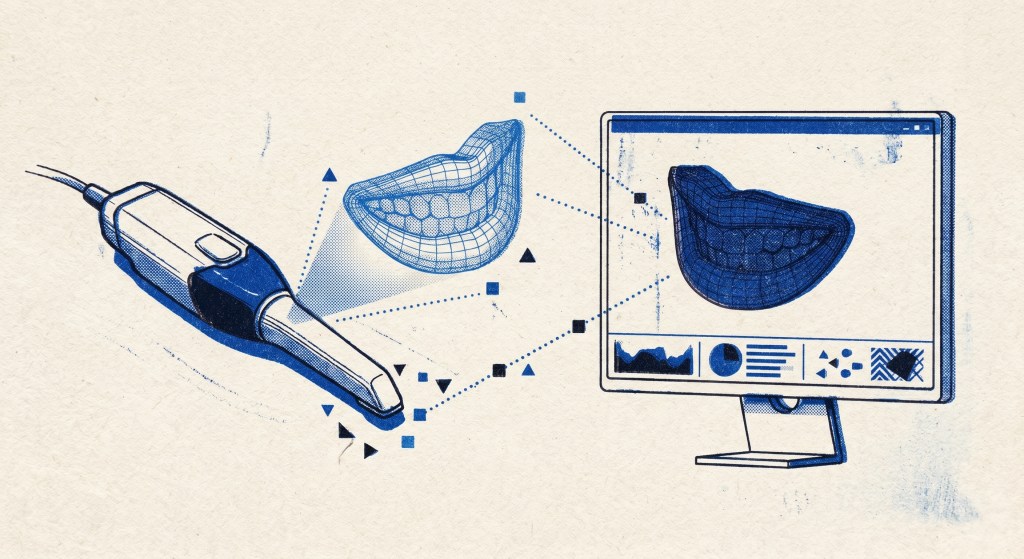
“We can take the scan with the patient watching it appear on the screen right in front of them. They’re engaged, they’re involved. Most patients have never seen their teeth from that perspective. It’s very rare for someone to walk up to a mirror, pull all their soft tissues out the way and start having a look. The scanner is a visual, three-dimensional version of something they’ve never seen — and that becomes a conversation starter.”
For cosmetic-leaning practices, that conversation is the conversion. Once a patient sees their own smile rendered in real time, sees the asymmetry, sees the wear, sees the gaps — and then sees a treatment simulator or smile design overlay showing what’s possible — the door opens. Treatment planning becomes collaborative instead of prescribed. “They can say actually, I don’t like this, this is what I’d change. Let’s have a play around. Let’s get to a result they’re excited about.”
The scanner diary — a system most practices aren’t running
Beyond the patient-experience layer, Lamia has been quietly rolling out an operational change worth stealing — regardless of whether you run one chair or twenty.
It’s called a scanner diary. On the practice management software, it lives as a dedicated column alongside the clinical diaries — and reception is trained to book directly into it.
The logic is simple: most practices have a scanner sitting idle for big chunks of the day, while the principal dentist is the bottleneck running every digital scan personally. Build a diary around the scanner — not just the dentist — and suddenly the asset is being used the way it should be.
“For a principal trying to grow their practice with two or three chairs, if they can delegate the scan to the nurse, they can quickly duck off and take a phone call or two. They get back to running the business. Ultimately, it saves the dentist time. They can focus on writing clinical notes, having consults — the things only they can do.”
It’s also, she points out, a quiet upskilling pathway for the nursing team — something most groups talk about but few operationalise.
Empowering nurses, buying back dentist time
This is where Lamia’s perspective shifts from operational to almost philosophical.
A dedicated scanner nurse — or a treatment coordinator with scanning responsibility — does more than free up clinical time. It gives nurses ownership of a part of the patient journey that has historically belonged exclusively to the clinician. They get their own list. Their own column on the diary. Their own remit.
“It’s a real opportunity for nurses to upskill. To progress. It’s something new for them and they have full control over it.”
For practice owners listening, the takeaway is twofold. You buy back chair time and you build retention into your nursing team — because nurses who can see a path forward are nurses who stick around.
Where the chair is heading
Lamia’s also a 3Shape ambassador, which has kept her close to their latest platform releases — though as she’s quick to point out, the underlying principle holds across the rest of the market too. iTero, Medit, Planmeca and others are all heading in the same direction: AI-assisted detection of caries, plaque, tooth wear, gingival recession — diagnostic layers that, in her words, give patients “another visual on top of what they’re already seeing.”
Her view: the scanner isn’t going to be replaced. It’s going to keep absorbing roles — diagnostic tool, education tool, monitoring tool, treatment planning tool. Whichever brand is sitting in your surgery, the practices that win will be the ones who train their full team around it instead of treating it as the dentist’s gadget.
The arc, in one sentence
There’s a thread that runs from an eight-year-old getting hit in the face all the way through to a senior leader training scanner workflows across more than 60 sites — and it’s a thread our industry doesn’t talk about enough.
Some of the best people in dentistry came in through the patient door. They remember what it felt like to be scared. They remember what it felt like to be made to feel comfortable. And they spend the rest of their careers trying to give other patients more of the second feeling and less of the first.
I’d be lying if I said I wasn’t one of them. I’m Tye, the 28-year-old founder of 230 Media. When I was eight, the dentist told me I had 80-year-old-looking molars — all crumbly, falling apart, in a kid’s mouth. I had oral surgery and silver fillings before most kids my age had even sat in a dental chair. I hated dentists. I hated hospitals. Today I run a global dental videography company that operates between Sydney and London, and dental practices are pretty much all I see. The eight-year-old version of me would have called that science fiction.
Lamia and I have very different jobs in dentistry. But underneath them, we share something a lot of the people I admire in this industry share: we both came in through the patient door. That’s why this conversation stuck.
Whether you’re a principal building your team, a TCO mapping out where you want to go, or a nurse looking at the scanner thinking am I missing what this thing can actually do? — there’s something in Lamia’s story worth sitting with.
What’s next: Dental and Me
The same instinct that took Lamia from the chair to the corporate side of dentistry is now showing up in her own platform. Dental and Me is where she shares the unfiltered version of life inside the industry — and it’s worth a follow whether you’re a clinician, a TCO, a nurse, or a principal trying to understand how the next generation of dental leaders is thinking. It’s also, I suspect, the early version of whatever comes next for her.
Find her on Instagram and Facebook at @dentalandme, on LinkedIn as Lamia Murray, or at dentalandme.co.uk.
230 Media is a dental-specialist content studio working with high-end cosmetic and restorative practices across Sydney’s Northern Beaches and London. We tell the human stories behind the craft — the kind that make patients feel something before they ever pick up the phone.